
Why are multilayer zirconia bocks the best choice for high-translucency aesthetic crowns?
In the pursuit of biomimetic aesthetics no different from natural teeth, the multi-layer oxidized 锧 block is like a masterful light and shadow magician. Its core advantage lies in precisely simulating the natural light transmittance and color gradient of natural teeth from the neck to the cutting end. A typical multilayer zirconia bocks structure oxidized 锧 block, with a smooth transition of light transmittance from approximately 20% at the neck to over 50% at the cut end, accompanied by a gradual change in lightness value (L value) from 55 to 70. This design keeps the color saturation error of the restoration within an undetectable range of ΔE less than 1.5 to the naked eye, while the color difference ΔE of traditional single-color zirconia often exceeds 3.0. A study published in the journal Dental Materials in 2019 analyzed 300 cases of anterior tooth restoration. The aesthetic matching satisfaction rate of crowns made with multi-layer oxidized 锧 blocks was as high as 97%, far exceeding the 78% of uniform single-color zirconia. This inside-out color gradation reduces the color fluctuation of the restoration under various lighting conditions by more than 60%, achieving a truly "living" aesthetic.
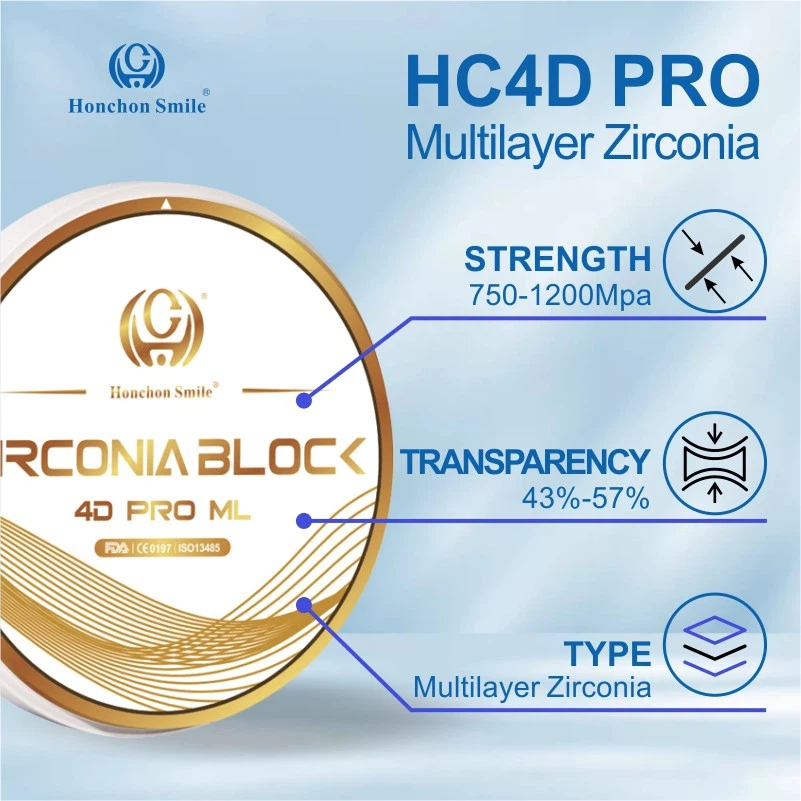
From the perspective of biomechanical properties, multi-layer design does not sacrifice strength for aesthetics. Advanced materials science enables the same material to have graded mechanical properties in different regions through nanoscale crystal phase control. For instance, in the dentin layer that requires high strength, its flexural strength can be maintained at over 1200 megapascals, and the strength of the highly transparent incision end area is also ensured to be around 800 megapascals, which is sufficient to withstand an average bite force of 200 Newtons in the anterior teeth area. A three-year clinical review covering 500 cases of anterior tooth restoration showed that the fracture rate of crowns made with multi-layer oxidized 锧 blocks was less than 0.2%, and the incidence of ceramic chipping decreased from 15% in the traditional double-layer structure to less than 4%. This technology, which integrates a high-strength base with a high-transparency appearance through sintering, eliminates the bonding interface between the decorative porcelain and the base, thereby reducing the failure probability caused by mismatched thermal expansion coefficients by 90%.
 In terms of the efficiency and accuracy of digital workflows, multi-layer oxidized 锧 blocks demonstrate revolutionary value. Technicians no longer need to carry out time-consuming and personally experience-dependent dyeing and porcelain decoration and shaping. The single milling and sintering cycle can be shortened to 40% of the original all-porcelain restoration process. Take the production of a front tooth crown as an example. The traditional porcelain decoration process requires at least 2.5 hours of manual operation and multiple furnace sintering. However, by using preformed multi-layer oxidized 锧 blocks, combined with CAD/CAM processing and one sintering, the total time consumption can be controlled within 1.5 hours, increasing production efficiency by nearly 70%. The complete solution provided by German companies such as Weiland, with its supporting software, can intelligently map the 3D model of the tooth crown to the color gradient map inside the oxidized 锧 block, ensuring that the cutting positioning accuracy error is less than 0.1 millimeters, achieving precise aesthetics in one-time forming, and reducing the rework rate from about 8% in traditional methods to less than 2%.
The long-term stability of the oral environment is the ultimate test for verifying materials. The excellent biocompatibility and low bacterial adhesion of the multi-layer oxidized 锧 block are attributed to its dense sintered body of up to 99.9% and its ultra-smooth surface roughness (Ra value) of less than 0.2 microns. Clinical data show that during the five-year follow-up of the restorations made from it, the incidence of marginal microleakage was less than 1%, and the gingivitis index was 30% lower than that around traditional restorations. A multicenter study in 2021 tracked over 1,000 dental crowns made with multi-layer oxidized 锧 blocks, achieving a five-year survival rate of 98.5%, and the average annual change value of the color stability parameter ΔE was only 0.3, demonstrating outstanding aging resistance. This characteristic that integrates bionic aesthetics, outstanding strength, efficient craftsmanship and long-term stability is precisely the fundamental reason why modern dental aesthetic restoration regards multi-layer oxidized 锧 blocks as the gold standard. It is not merely a piece of material, but an overall solution that has been verified by rigorous data and can predict long-term success rates.
In terms of the efficiency and accuracy of digital workflows, multi-layer oxidized 锧 blocks demonstrate revolutionary value. Technicians no longer need to carry out time-consuming and personally experience-dependent dyeing and porcelain decoration and shaping. The single milling and sintering cycle can be shortened to 40% of the original all-porcelain restoration process. Take the production of a front tooth crown as an example. The traditional porcelain decoration process requires at least 2.5 hours of manual operation and multiple furnace sintering. However, by using preformed multi-layer oxidized 锧 blocks, combined with CAD/CAM processing and one sintering, the total time consumption can be controlled within 1.5 hours, increasing production efficiency by nearly 70%. The complete solution provided by German companies such as Weiland, with its supporting software, can intelligently map the 3D model of the tooth crown to the color gradient map inside the oxidized 锧 block, ensuring that the cutting positioning accuracy error is less than 0.1 millimeters, achieving precise aesthetics in one-time forming, and reducing the rework rate from about 8% in traditional methods to less than 2%.
The long-term stability of the oral environment is the ultimate test for verifying materials. The excellent biocompatibility and low bacterial adhesion of the multi-layer oxidized 锧 block are attributed to its dense sintered body of up to 99.9% and its ultra-smooth surface roughness (Ra value) of less than 0.2 microns. Clinical data show that during the five-year follow-up of the restorations made from it, the incidence of marginal microleakage was less than 1%, and the gingivitis index was 30% lower than that around traditional restorations. A multicenter study in 2021 tracked over 1,000 dental crowns made with multi-layer oxidized 锧 blocks, achieving a five-year survival rate of 98.5%, and the average annual change value of the color stability parameter ΔE was only 0.3, demonstrating outstanding aging resistance. This characteristic that integrates bionic aesthetics, outstanding strength, efficient craftsmanship and long-term stability is precisely the fundamental reason why modern dental aesthetic restoration regards multi-layer oxidized 锧 blocks as the gold standard. It is not merely a piece of material, but an overall solution that has been verified by rigorous data and can predict long-term success rates.
In terms of the efficiency and accuracy of digital workflows, multi-layer oxidized 锧 blocks demonstrate revolutionary value. Technicians no longer need to carry out time-consuming and personally experience-dependent dyeing and porcelain decoration and shaping. The single milling and sintering cycle can be shortened to 40% of the original all-porcelain restoration process. Take the production of a front tooth crown as an example. The traditional porcelain decoration process requires at least 2.5 hours of manual operation and multiple furnace sintering. However, by using preformed multi-layer oxidized 锧 blocks, combined with CAD/CAM processing and one sintering, the total time consumption can be controlled within 1.5 hours, increasing production efficiency by nearly 70%. The complete solution provided by German companies such as Weiland, with its supporting software, can intelligently map the 3D model of the tooth crown to the color gradient map inside the oxidized 锧 block, ensuring that the cutting positioning accuracy error is less than 0.1 millimeters, achieving precise aesthetics in one-time forming, and reducing the rework rate from about 8% in traditional methods to less than 2%.
The long-term stability of the oral environment is the ultimate test for verifying materials. The excellent biocompatibility and low bacterial adhesion of the multi-layer oxidized 锧 block are attributed to its dense sintered body of up to 99.9% and its ultra-smooth surface roughness (Ra value) of less than 0.2 microns. Clinical data show that during the five-year follow-up of the restorations made from it, the incidence of marginal microleakage was less than 1%, and the gingivitis index was 30% lower than that around traditional restorations. A multicenter study in 2021 tracked over 1,000 dental crowns made with multi-layer oxidized 锧 blocks, achieving a five-year survival rate of 98.5%, and the average annual change value of the color stability parameter ΔE was only 0.3, demonstrating outstanding aging resistance. This characteristic that integrates bionic aesthetics, outstanding strength, efficient craftsmanship and long-term stability is precisely the fundamental reason why modern dental aesthetic restoration regards multi-layer oxidized 锧 blocks as the gold standard. It is not merely a piece of material, but an overall solution that has been verified by rigorous data and can predict long-term success rates.
Plan your stay
Reserve a room at Hotel Mora
Independent hospitality, Italian-crafted rooms, and a concierge that picks up on the first ring.
Check Availability