
What a Pool Account Holds Beyond the Hashrate Number
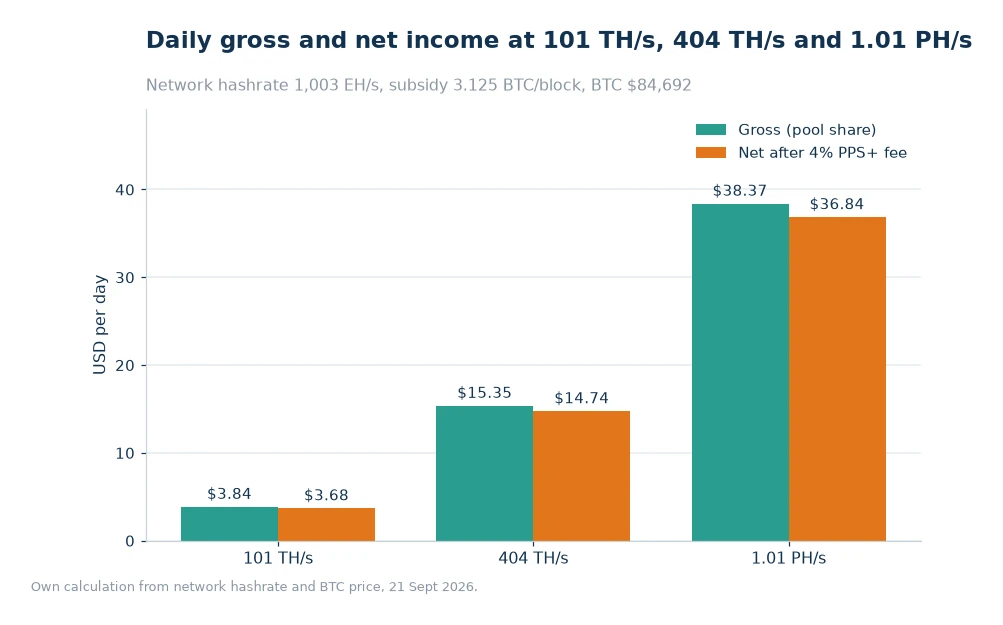
A mining account looks like one screen with a number on it, but the useful parts sit underneath: where the coins land, what they can be swapped into, and whether they can be borrowed against without selling. At 101 TH/s the daily credit is 0.00004531 BTC, $3.84 gross and $3.68 after the listed 4% on the block-reward component. What happens to that $3.68 after it arrives is a separate decision from mining it.
Key takeaways
- 101 TH/s credits 0.00004531 BTC a day, or $3.84 gross at $84,692, falling to $3.68 after the listed 4%.
- Mining income settles hourly under PPS+, so the balance changes 24 times a day rather than once a month.
- Withdrawals of mining income carry no fee, which makes moving coins out a genuine option rather than a last resort.
- Wallet, conversion and collateral features sit in the same login as the hashrate chart, so no step requires a second account.
The first setting is not the hashrate
Before a machine is pointed at a pool, someone has to choose the coin, the worker name and the address that receives the credit. Those choices are boring and they outlast every hardware decision made afterwards. A wrong address is not a performance problem that shows up on a chart; it is a payout that goes somewhere else and does not come back.
The account structure is worth setting up once, deliberately, for the same reason. Decide whether the coins should accumulate in BTC, be converted automatically, or be withdrawn on a schedule that matches a bill. Each option is a single switch, and each produces a different-looking month even when the mining output is identical.
One login, three jobs
On ViaBTC Mining Pool, the first screen answers how much was mined. The wallet answers where it sits and in which currency. The finance side answers whether the balance can be used without selling it. Splitting those three jobs across three services is possible, and every transfer between them adds a step, a fee and a delay.
Keeping them together changes the arithmetic of a small operation. A miner who would otherwise sell coins on a weak day to cover a repair can instead look at a loan against the balance and decide later. That is not a recommendation to borrow; it is the difference between having a choice at 2 a.m. and having only one option.
Why hourly settlement rewards attention
PPS+ pays every hour against current difficulty, which turns the balance into a series rather than a monthly total. A series is easier to audit: a gap is visible, a step down is visible, and a machine that quietly stopped submitting shares shows up as a flat line long before the month ends.
It also changes how conversion should be handled. Converting a monthly sum means one decision per month at one price. Converting hourly flows means many small decisions, and doing that by hand is impractical. Auto Conversion exists for exactly this shape of income, and a miner who prefers to hold a different coin can set the rule once instead of watching the clock.
Reading the dashboard in layers
The top layer is hashrate: what your machines are submitting. The middle layer is the pool's share of the network, which decides how much a unit of hashrate is worth. The bottom layer is the account balance, which is the only one that can be spent. Confusing the layers produces odd conclusions, such as believing a rise in pool hashrate is good news for an individual miner's daily credit.
A sensible weekly check moves down the layers in order. Is every worker reporting? Is the pool still a meaningful share of the network? Is the balance tracking the expected daily credit? Three questions, two minutes, and a much shorter conversation when something finally breaks.
Who should keep custody separate
There are legitimate reasons to hold coins outside the mining account: a company treasury policy, a hardware wallet for long-term storage, or a jurisdiction that treats mining proceeds differently from held assets. None of those reasons changes the arithmetic of the daily credit, and none of them requires moving every payout at once. A scheduled withdrawal that leaves a working balance behind satisfies both the policy and the power bill.
What a second account really costs
Splitting mining from custody looks tidier on paper and costs two things in practice. The first is a transfer: every coin that leaves the pool for an outside wallet is a transaction with a fee and a confirmation wait attached. The second is a reconciliation: two statements that must be matched by hand before anyone can say what the operation actually earned in a month.
Neither cost is large on its own. Together they explain why operators with a handful of machines tend to consolidate, while operators running a treasury function with separate custody rules accept the overhead because someone else requires it. The choice is organizational, not technical, and it is worth making once rather than revisiting every quarter.
Four ways to handle the payout
The table treats the same daily credit as four different decisions. Dollar values use the 101 TH/s tier, and the timing column reflects how PPS+ settlement works rather than a promise about any particular day.
| Choice | What happens | Fits when |
|---|---|---|
| Leave it in BTC | Balance grows by 0.00004531 BTC a day | You expect to spend or move coins later |
| Auto Conversion | Each credit is swapped by a standing rule | Costs are in another currency |
| Withdraw on a schedule | Coins leave with no mining payout fee | The wallet is elsewhere by policy |
| Pledge as collateral | Balance stays put while a loan is outstanding | Liquidity is needed without selling |
Worked example
Follow the 101 TH/s credit from network share to a spendable balance.
- Begin with the network rate: 450 BTC a day spread over 1,003,000,000 TH/s is 0.00000044865 per TH/s.
- 101 TH/s: 101 × 0.00000044865 = 0.0000453137 BTC a day.
- Gross dollars: 0.0000453137 × 84,692 = $3.8377, rounded to $3.84.
- After the listed 4% on the block-reward component: 3.8377 × 0.96 = $3.6842, rounded to $3.68.
- Hourly credit: 0.0000453137 ÷ 24 = 0.000001888 BTC, about 15.9 cents.
- 404 TH/s, four times the tier: $15.35 gross and $14.74 net.
- 1.01 PH/s, ten times the tier: $38.37 gross and $36.84 net.
- One month of net credit at 101 TH/s: 30 × 3.6842 = $110.53.
Frequently asked questions
Does the pool account hold the coins or send them onward?
Both are possible. Mining income settles into the account balance hourly under PPS+, and from there it can stay in the multi-currency wallet, be converted, or be withdrawn; withdrawal of mining payouts carries no fee.
Is a separate wallet needed for converted coins?
No. Auto Conversion works inside the same account, so a balance can be held in a different currency without an external transfer or a second login.
Can a balance be used without selling the coins?
Yes, through Collateral-Pledged Loans, where coins are pledged rather than sold and redeemed once the loan is repaid. The decision is a liquidity choice, not a mining one, and it carries its own obligations.
Set the account up before the machine arrives
Decide the payout address, the conversion rule and the withdrawal rhythm while the hardware is still in transit. Those three choices take an afternoon and determine the shape of every statement that follows. Then check the first week of hourly credits against the arithmetic above; if the series matches, the setup is right and the rest is maintenance. The wallet page describes the balance side, and the calculator will restate the daily credit at whatever hashrate you actually install.
Account, wallet and conversion documentation read 21 Sept 2026[1]; chain values on the same date were 1,003 EH/s, 3.125 BTC every block, 144 blocks a day and $84,692 per BTC. Published 24 Oct 2026. Figures assume continuous uptime and current difficulty.