
Perfume OEM in China: Small Atelier or Established Export Factory?
For a first order, a founder choosing OEM perfume manufacturing in China usually faces two realistic routes: a small flexible studio that will do almost anything for you, or an established export factory with systems in place that expects to do things its own way. The first is cheaper to start and easier to talk to; the second is harder to negotiate with but far easier to scale and to document. Choice A is not better — the two are optimised for different stages, and picking the wrong stage is the expensive mistake.
Key takeaways
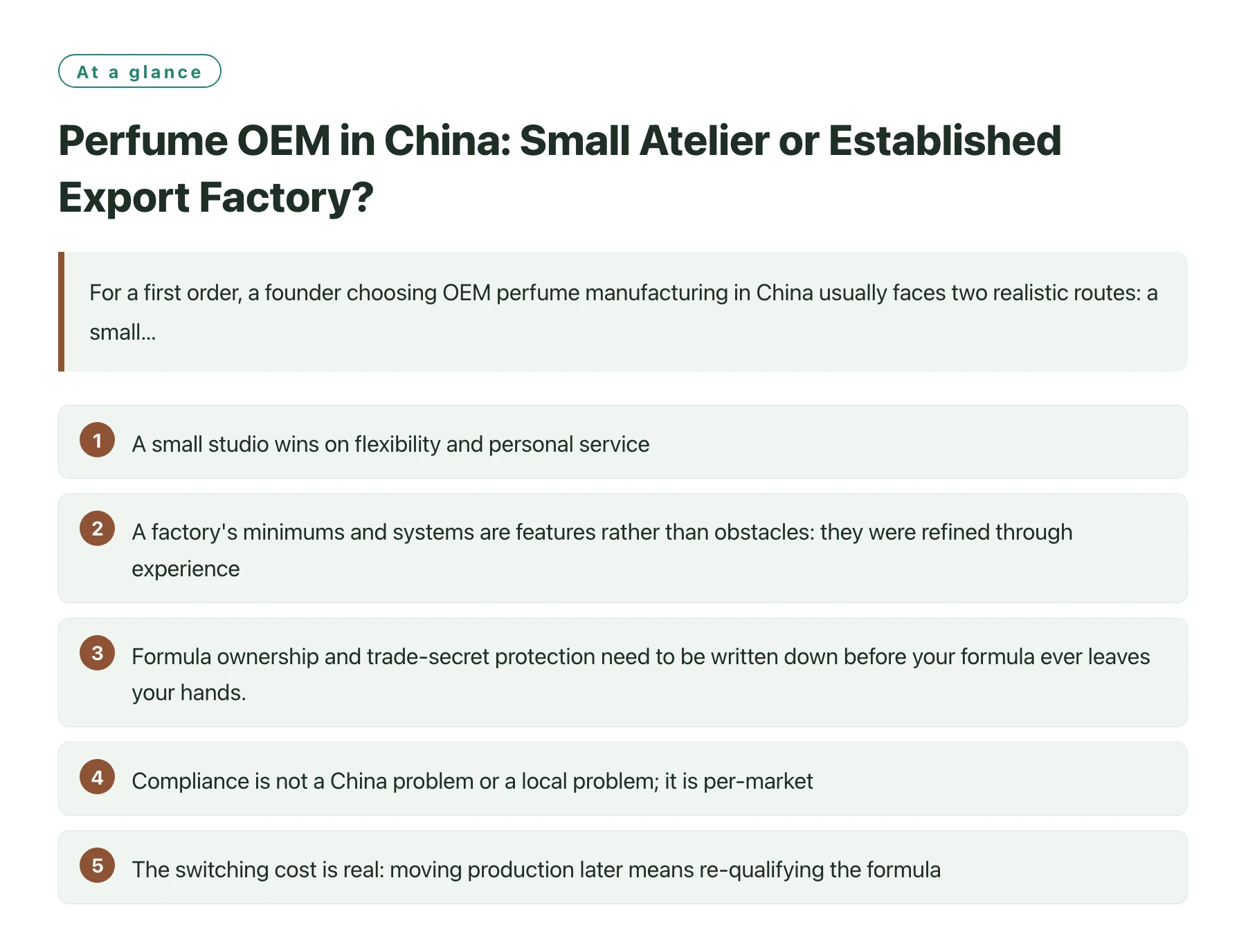
- A small studio wins on flexibility and personal service; an export factory wins on repeatability, documentation and scale — pick by what your next twelve months need.
- A factory's minimums and systems are features rather than obstacles: they were refined through experience, and they protect you from your own rush.
- Formula ownership and trade-secret protection need to be written down before your formula ever leaves your hands.
- Compliance is not a China problem or a local problem; it is per-market, and an export factory will carry more of that burden for you than a studio will.
- The switching cost is real: moving production later means re-qualifying the formula, the mould and the process — so pick a route you can stay with for a year or two.
Founders describe the same week in two ways. With a studio, they say: they made exactly what I wanted. With a factory, they say: they gave me a spec and told me what was possible. Both sentences describe the same trade-off — who holds the process.
This comparison ignores branding and price positioning, because those are your job. It looks only at the production route, which is the decision founders get wrong before the brand question ever matters.
Route A versus route B
| Dimension | Small atelier / studio | Established export factory |
|---|---|---|
| Minimum orders | Low enough for a test run | Higher, structured by formula and pack |
| Custom work | High flexibility, hand-made feel | Standardised routes, controlled variance |
| Unit cost at scale | Stays higher | Falls faster with volume |
| Documentation and testing | Thin, often outsourced | Built in, with batch records |
| Compliance support | Limited to what they know | Often multi-market dossiers |
| Communication | Founder talks to the maker | Key account or project manager |
| Best fit | Prove demand, up to a few thousand units | Commit to a product and grow it |
Notice what is not on the table: quality or honesty. Both exist in both routes; the difference is how the process is held, documented and scaled.
What each route gives a first-time founder
The studio route solves the first problem a founder has: getting anything made at all. Low minimums and direct conversation mean you can prove a concept with real product instead of mock-ups and iterate until the scent feels right. The cost is that everything you learn stays with you — the studio is not building the documentation pack a retailer will eventually demand.
The factory route solves the second problem: repeatability. An export manufacturer has made the same kind of product for years, so filled weight tolerances, batch records and stability data exist before you ask for them, and the machinery of compliance is part of the quotation rather than an extra project. Where a third-party layer is needed, labs that audit cosmetics GMP can step in on demand [1].
Whatever the route, ask to see how custom fragrance manufacturing is organised in practice — who compounds, who fills, who tests — because the line that will fill your bottles is the specification you are actually buying custom fragrance manufacturing.
Where ownership and protection sit
OEM means your specification, your formula or your perfume house's formula runs on someone else's line. Before it ships, decide in writing who owns the formula, who may see the accord documentation and what happens to the material if the relationship ends. Trade secrets and industrial designs are separate mechanisms — designs can be registered nationally or through the international route administered by WIPO, and registration is only useful if the brand holds the rights [2].
The protection is contractual: a non-disclosure agreement, an exclusivity clause and a documented confidentiality regime for the formula file. Get it signed before the first sample, not after the first hit.
Making the call
The decision rule that works: if the product idea still has open questions — dosage form, price point, audience — start with a small studio and spend money on learning. If the concept is fixed and the question is volume, dates and documentation, start with an export factory and spend money on control.
A middle path exists and is common: develop with a flexible partner, then transfer the qualified formula to a larger operation. A partner that runs a fragrance OEM/ODM production partner model at scale makes that hand-off easier than a studio-only supplier can.
When your route is an established Chinese producer, the check is concrete: the questions to ask are the same everywhere — who holds the formula, who signs the batch record, who pays for a failed stability test. A manufacturer's own explanation of its production, such as the Xuelei fragrance production process it describes on its site, is where those answers should be visible before you ask.
Whatever you choose, freeze the process, not just the product. The formula, the mould, the fill spec and the stability file are the assets that survive a switch of production site; the relationship is not one of them.
Sources
- SGS: Cosmetics, Personal Care & Household Testing —— Testing, inspection and certification services for cosmetics and personal care, including microbiological, stability and safety testing aligned with cosmetics GMP.
- WIPO — World Intellectual Property Organization —— The UN agency for intellectual property; resources on industrial design and patent protection relevant to product and packaging design.
Frequently asked questions
Is it cheaper to start with a small studio in my own country?
Usually cheaper per unit at low volumes and cheaper to communicate with. If you are proving demand with a few hundred units, it is often the sensible first step. The cost appears at scale, when you need documentation the studio never built.
Can Chinese OEM factories handle small orders?
Some can, but small in factory terms is not small in founder terms. Minimums are usually set by formula batch size and packaging runs, so ask for the minimums on each component rather than a single magic number.
How do I protect my formula when using a Chinese OEM?
Contractually: non-disclosure and exclusivity agreements, written ownership of the formula, and a confidentiality regime for the documentation. Registration also helps where applicable, but the contract is the first line of defence.
Should I use one supplier for development and another for production?
It is a common route, but warn both sides about the hand-off. Re-qualification is real work: the formula must be rebuilt and tested at the new site, which costs months if it is not planned.
What should my first factory order be sized at?
Big enough to be meaningful, small enough to be survivable. A first order should prove the process — fill, documentation, delivery — before you commit the budget that depends on it.
Reserve a room at Hotel Mora
Independent hospitality, Italian-crafted rooms, and a concierge that picks up on the first ring.
Check Availability